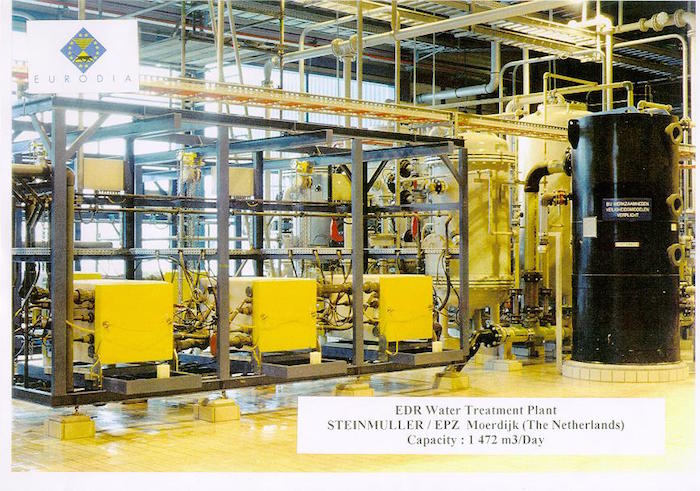
Electrodialysis (ED) is a very versatile technology for the separation of difficult mixtures. Electrosynthesis Company, Inc. offers expertise in electrodialysis R&D as well as in the engineering and construction of ED systems for the laboratory, piloting, and production.
What is Electrodialysis (ED)?
Electrodialysis is an electromembrane process in which ions are transported through ion permeable membranes from one solution to another under the influence of a potential gradient. The electrical charges on the ions allow them to be driven through the membranes fabricated from ion exchange polymers. Applying a voltage between two end electrodes generates the potential field required for this. Since the membranes used in electrodialysis have the ability to selectively transport ions having positive or negative charge and reject ions of the opposite charge, useful concentration, removal, or separation of electrolytes can be achieved by electrodialysis.
Ion Permeable Membranes
The ion permeable membranes used in electrodialysis are essentially sheets of ion-exchange resins. They usually also contain other polymers to improve mechanical strength and flexibility. The resin component of a cation-exchange membrane would have negatively charged groups (e.g., -SO3–) chemically attached to the polymer chains (e.g., styrene/divinylbenzene copolymers). Ions with a charge opposite to the fixed charge (counter ions) are freely exchanged at these sites. The concentration of counter ions (e.g., Na+) is relatively high; therefore, counter ions carry most of the electric current through the membrane. The fixed charges attached to the polymer chains repel ions of the same charge (co-ions), in this case the anions. Since their concentration in the membrane is relatively low, anions carry only a small fraction of the electric current through a cation permeable membrane. Attachment of positive fixed charges (e.g., -NR3+ or C5H5N+R where commonly R = CH3) to the polymer chains forms anion permeable membranes, which are selective to transport of negative ions, because the fixed -NR3+ groups repel positive ions. This exclusion, as a result of electrostatic repulsion, is called Donnan exclusion.
Ion-exchange polymers such as poly(styrene sulfonic acid) are water soluble, so crosslinking is needed to prevent dissolution of ion permeable membranes. Divinylbenzene is used to cross link polystyrene chains. The degree of cross-linking and the fixed-charge density affect the membrane’s properties in opposite ways. Higher crosslinking improves selectivity and membrane stability by reducing swelling, but it increases electrical resistance. High charge density reduces resistance and increases selectivity, but it promotes swelling and thus necessitates higher crosslinking. A compromise between selectivity, electrical resistance, and dimensional stability is achieved by proper adjustment of crosslinking and fixed-charge densities.
Bipolar Membranes
Bipolar membranes consist of an anion-permeable membrane and a cation permeable membrane laminated together. When this composite structure is oriented such that the cation-exchange layer faces the anode it is possible, by imposing a potential field across the membrane, to spit water into proton and hydroxyl ions. This results in the production of acidic and basic solutions at the surfaces of the bipolar membranes. Multiple bipolar membranes along with other ion permeable membranes can be placed between a single pair of electrodes in an electrodialysis stack for the production of acid and base from a neutral salt.
There are substantial advantages to water splitting with bipolar membranes. Since there are no gases evolved at the surface or within the bipolar membranes, the energy associated with conversion of water to O2 and H2 is saved, and the power consumption is about half that of electrolytic cells. Compared to the electrodes used in conventional electrolytic cells, the bipolar membranes are inexpensive. Where dilute (e.g., < 1 M) acids or bases are needed, bipolar membranes offer the prospect of low cost and minimum unwanted byproducts.
Electrodialysis Applications
Reduce Electrolyte Content
- Potable from brackish water
- Food products – whey, milk, soy sauce, fruit juice
- Nitrate from drinking water
- Cooling tower water
- Boiler feed water
- Rinse water for electronics processing
- Effluent streams
- Electroless plating baths
- Blood plasma to recover proteins
- Pickle brines to recover flavor
- Sugar and molasses
- Amino acids
- Potassium tartrate from wine
- Chloride purge in Kraft paper process
- Photographic developer regeneration
- Fiber reactive dyes
Recover Electrolytes
- Pure NaCl from seawater
- Ag(I) salts from photographic waste
- Ni(II) from electroplating rinse waters
- Zn(II) from galvanizing rinse water
- Salts of organic acids from fermentation broth
- Amino acids from protein hydrolysates
- Acids from metal pickling baths and rinse
- HCl from cellulose hydrolysate
Miscellaneous
- Salt splitting
- Metathesis
- Concentrate reverse osmosis brines
- Ion substitution
As you can see, ED has a wide range of applications in many fields. Our experience with electrodialysis can help you determine whether it is appropriate technology for your needs.